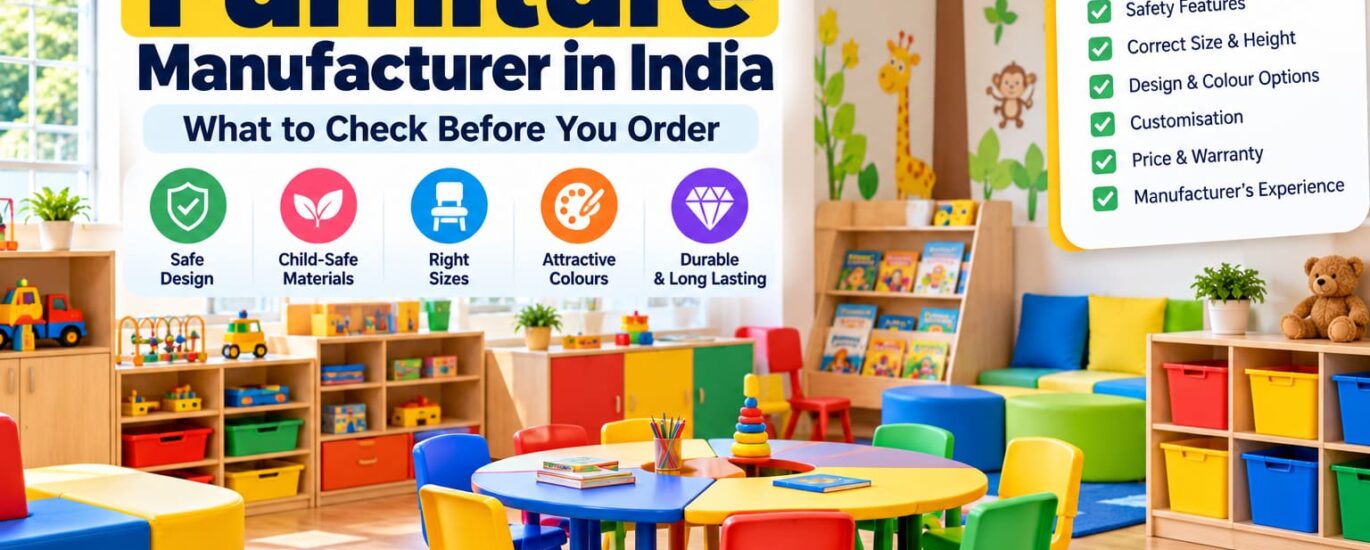
Walk into a good preschool and you notice the furniture before you notice anything else. Small tables at the right height, chairs that children can pull out by themselves, shelves they can reach, and colours that feel friendly instead of loud. Now think of the opposite: chairs too tall for small legs, sharp corners at eye level, and wobbly tables that tip when a child leans on them. The difference usually comes down to the maker. If you are choosing a play school furniture manufacturer India has many options, but they are not equal, and a wrong choice costs you in safety, repairs and parent confidence.
Why Preschool Furniture Is Different
Furniture for toddlers and nursery children is not a shrunken version of school furniture. Children aged two to five have different body proportions, less coordination and a habit of putting everything in their mouths. They climb on chairs, drag tables and sit on the floor for activities. Furniture has to handle all of that, and it should help children become independent by being easy to use. A chair a child can sit on and get off without help, or a shelf they can reach without climbing, teaches confidence as much as it serves a function.
What a Typical Play School Needs
Most preschools need a core set of items. Activity tables and matching chairs form the base, often in several heights for different age groups. Storage units for toys, books and art supplies keep the room tidy, and low open shelves let children choose their own materials. Reading corners with cushioned seating or small sofas create a calm space. Many schools add nap mats or cots, lockers or cubbies for bags, and teacher desks sized for adults. Some also use soft seating, play kitchens and role-play furniture. Plan the list around your daily routine, rather than buying everything at once.
Materials That Matter
The material decides how long furniture lasts and how safe it is. Wood and good-quality plywood feel warm and sturdy, and can be finished with smooth, rounded edges. MDF is smooth and takes colours well but can swell if water gets in, so ask how the edges are sealed. Moulded plastic is lightweight, easy to wipe and common for chairs and tables, though cheaper versions can crack or fade in sunlight. FRP and similar materials suit outdoor or damp areas. Whatever the material, check the finish. Paints and lacquers should be non-toxic and suitable for children, since toddlers will chew on edges. Ask the manufacturer directly what paints they use and whether they can show any testing or certification for them.
Safety Details Worth Checking
Run your hand along every edge and corner. They should be rounded and smooth, with no splinters, exposed screws or sharp metal. Tables and chairs should be stable and hard to tip over, and shelves should be fixed or weighted so a child cannot pull them down. Check gaps and joints that could trap small fingers. Look at the weight too. Furniture that is too heavy is hard for staff to move and risky if it falls, while furniture that is too light slides around easily. Ask whether stackable chairs lock safely when stacked, and whether any parts can come loose and become a choking hazard.
Getting the Size Right
Sizing is where many orders go wrong. A chair that is too high leaves a child’s feet dangling and makes sitting uncomfortable, and a table that is too tall strains small shoulders. Ask your manufacturer for the seat height and table height of each product, and compare them with your age groups. Many suppliers offer separate sizes for toddlers, nursery and kindergarten classes. If you can, ask for a sample or visit a school that uses the same furniture before placing a bulk order.
Design, Colour and Customisation
Bright colours attract children, but too many strong colours in one room can feel chaotic. Many schools choose a calm base colour with bright accents. A manufacturer who can customise colours, add your school’s logo or adapt a design to your classroom size is valuable, especially if your rooms are not standard. Think about layout early. Leave clear walking space around tables, keep the exits unblocked and place quieter areas, like reading corners, away from active play zones.
Comparing Quotations
Prices depend on material, thickness, finish, size, customisation, quantity and delivery distance. Ask for a written quotation that lists each item with dimensions and materials, so you can compare suppliers properly. A very low price usually means thin boards, weak joints or cheap paint. Ask about the warranty, and find out how repairs and replacements are handled. Bulk orders for new schools often bring a better rate, but only if quality stays consistent across the entire batch.
Choosing a Manufacturer
Look for a company that makes its own furniture, can show finished projects and answers your questions without hedging. Ask for photos or addresses of preschools that use their products, and speak to the owners about how the furniture has held up after a year or two. Go Green Play Equipment offers play school furniture along with play equipment and flooring, which makes it convenient to equip a classroom and play area from one supplier. For schools in Hyderabad and across Telangana, you can also look at the work of Telangana Corporate Services when you compare options.
Final Thoughts
Good preschool furniture should be safe, the right size, easy to clean and built to survive daily use by very small, very energetic people. Ask about materials, finishes, dimensions and warranty, visit a real installation if you can, and avoid choosing on price alone. To discuss furniture for your play school, contact Go Green Play Equipment with your class sizes, age groups and room layout.