A spiral slide is the one piece of equipment that makes people stop and look up. It’s tall, it twists, and children treat it as a small adventure. It’s also one of the more complicated things to buy, because a lot can go wrong at height. If you’re talking to a spiral slides manufacturer in India, these are the points worth getting clear before any money changes hands.
Open Spiral or Tube Spiral?
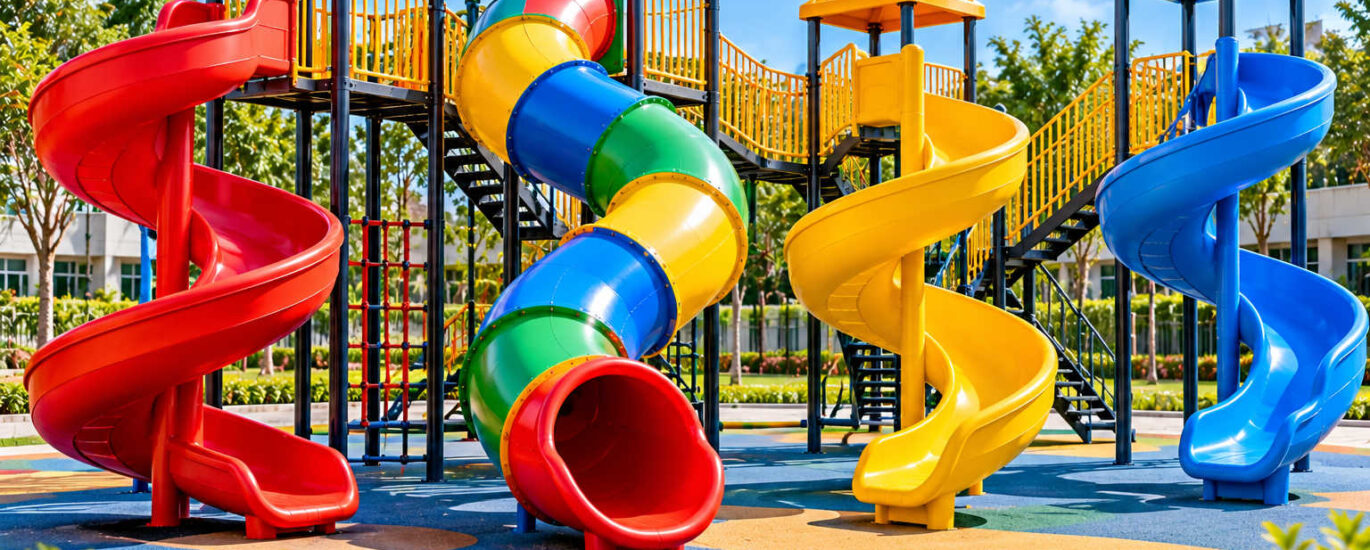
There are two main kinds. An open spiral has a curved slide bed with raised sides, so the child can see out as they go down. A tube spiral is fully enclosed, like a twisting pipe.
Open slides feel safer to many parents because they can see their children the whole way. Tube slides are more thrilling and keep rain and sun off the rider, but they need good ventilation and a smooth interior, and some parents don’t like not being able to see inside. Neither is better. The right one depends on the age group and on how much supervision the space has.
Materials Decide How It Ages
Most spiral slides in India are built from FRP, moulded plastic or a combination with steel. Each has its own habits.
FRP, which is fibre-reinforced plastic, doesn’t rust and can be moulded into smooth curves. The quality varies a lot between makers. Thin walls, a weak outer coat or rough inner surfaces show up within a couple of seasons as fading, cracking and skin-scratching patches.
Rotationally moulded plastic is common for smaller slides. It’s light and cheap, but strong sun can make it brittle over time unless it’s UV-stabilised.
Stainless steel slide beds are popular for open slides because they’re smooth and tough, but they get hot in direct sun. In an Indian summer that matters. A steel slide facing west in the afternoon can be too hot to touch.
The supporting frame is usually galvanised or powder-coated steel. Look at the thickness of the pipe, the quality of the welds and the type of bolts.
Height and Age
A spiral slide is only as safe as its height suits the child. Tall slides need guard rails and a protected platform at the top, plus a comfortable exit at the bottom. For younger children, a lower spiral or a straight slide is a better choice. Ask the manufacturer what age group each model is designed for and don’t stretch it.
The exit matters as much as the ride. There should be enough flat run-out so a child slows down naturally and doesn’t hit the ground at speed. The surface below should be soft, such as rubber tiles or thick sand. Concrete or bare tiles at the bottom of a spiral slide isn’t acceptable.
Space and Footprint
People underestimate how much room a spiral slide takes. The structure itself is round and compact, but you need clear space around it for queuing, for the exit and for children running past. Keep it away from walls, swings and busy walkways. If you’re short on ground, a smaller multi-play unit with a spiral element might make more sense than a stand-alone tower.
Installation Is Not an Afterthought
A spiral slide is a tall, heavy, curved structure. It needs proper footings and careful assembly, and the segments must fit together smoothly with no sharp edges at the joins. Ask who installs it, how long it takes and whether the manufacturer’s team does it or a contractor. A bad join between two slide sections can scratch a child’s skin or trap clothing, even if everything else is perfect.
Questions Worth Asking a Manufacturer
Ask which material the slide bed is made of and how thick it is. Ask whether the plastic or FRP is UV-treated. Ask how the sections are joined and whether the joins are smooth inside. Ask what age range it suits and what height it reaches. Ask what the warranty covers, especially cracking and fading. Ask whether you can see an installed spiral slide that’s been outside for a few years. A manufacturer who has built a lot of these will answer without hesitation.
Things That Should Make You Cautious
Be wary of a price that’s far below everyone else’s. It usually means thin walls or a poor finish. Be wary if there are no photos of past installations, or if the manufacturer can’t explain how heights, ages and safety zones were worked out. Be wary if the answers to simple questions about materials are vague.
Looking After It
Check the bolts and joints regularly, especially after heavy rain. Look at the slide surface for cracks, rough patches or fading. Wipe it down so dust and leaves don’t build up. In summer, test the surface temperature before letting children use it, and consider shade. Remove a slide from use if you see a crack or a loose section. A closed slide is better than an injured child.
Putting It Together
Think about the whole play area, not just the slide. If you’re planning other equipment as well, Go Green Play Equipment offers outdoor playground products that can sit alongside a spiral slide. If your project also includes an outdoor fitness area or other outdoor furniture, Telangana Corporate Services can help with that side.
A good spiral slide looks simple from the ground. That simplicity comes from careful choices about height, materials, joins and surfacing. Make those choices well and the slide will still be the first thing children run to years from now.